
Channel Incentive Programs in India: Types, Rewards and Tax


What Is a Channel Incentive Program?
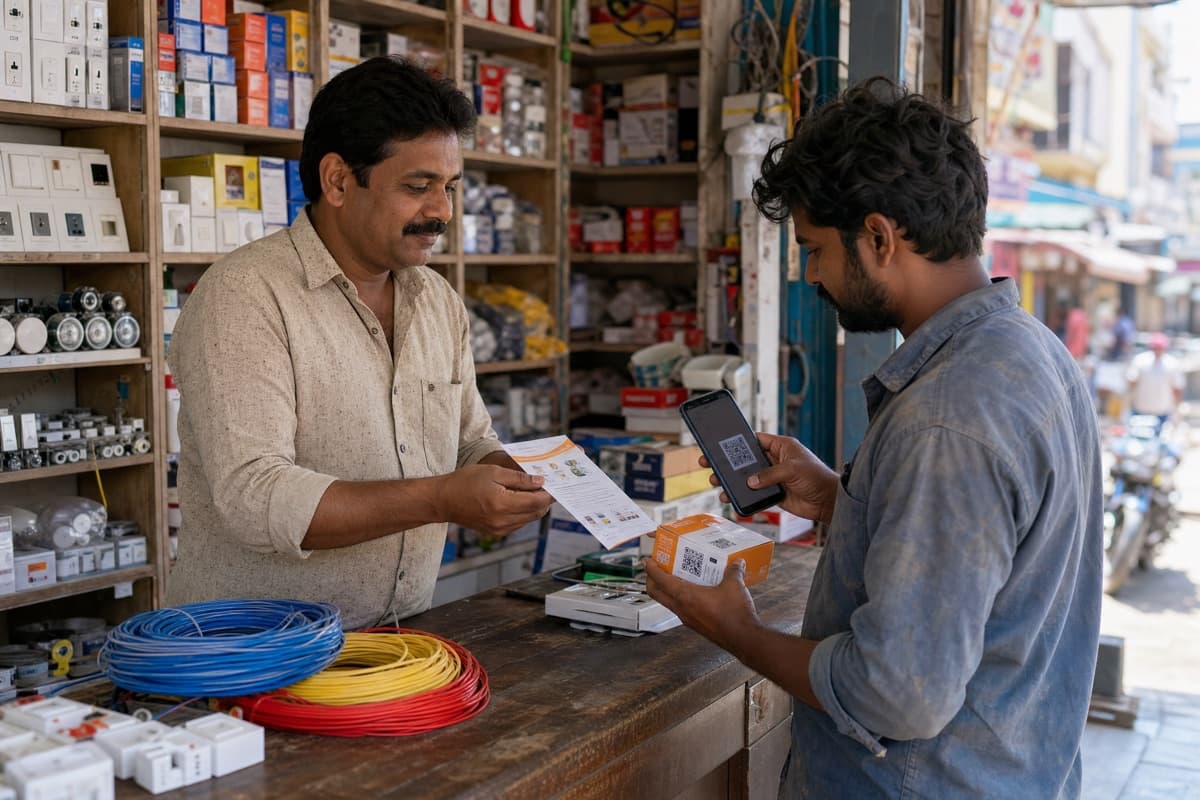
A channel incentive program is a set of rewards a brand pays to the businesses and people who sell its products for it: distributors, retailers, the staff at their counters, and trade influencers such as electricians and plumbers. The usual types are target and slab schemes, display incentives, spot incentives for counter staff, QR-scan points and contests.
Picking the type is the easy part. The harder choice is the form the reward takes: a credit note against the next order, a UPI transfer, a gold coin, a phone, or a trip for the top 20 dealers. In India, two things settle that: who earns the reward, and how tax law treats that form of it. A rebate by credit note and a dealer trip to Goa can cost you the same, but only the trip comes under the TDS rule for business benefits.
"Channel incentive program" and "channel partner incentive program" mean the same thing. A channel partner program is the wider frame around it: who can sign up, the tiers, the margins and the support a partner gets. A channel loyalty program is one long-running kind of incentive, where partners earn points over months or years; our channel loyalty program guide covers how to design one.
Types of Channel Incentives
Each type pays for one behaviour.
| Type | Who usually earns it | Usual reward form | Proof used to check it | TDS on the benefit? (194R) |
|---|---|---|---|---|
| Target or slab scheme | Distributors, dealers, retailers | An extra discount or rebate, settled by credit note | Invoices; secondary sales data from the distributor management system (DMS) | No: discounts and rebates are outside the rule |
| Display or visibility scheme | Retailers | Extra margin, points, or a cash incentive for the space | Photos of the display; audit visits | A cash or in-kind incentive, yes. A discount or rebate, no |
| Spot incentive (SPIFF) | Salespeople and in-store demonstrators (ISDs) at the counter | A small amount per unit sold, often by UPI | Sale entries in an app; invoice or serial numbers | Yes, in the name of the dealer or retailer whose staff earn it |
| QR-scan scheme | Electricians, plumbers, painters, carpenters, mechanics | Points per product, redeemed as a bank or UPI transfer, a voucher or a gift | A QR code on each pack, scanned at the site; KYC at sign-up | Yes |
| Contest with a trip or gift | Top dealers and retailers | A trip, a gold coin, a phone, a TV | The ranking the contest is judged on | Yes |
Global guides also list two kinds of marketing money: market development funds (MDF), given against a business case a partner submits, and co-op funds, which build up as a partner's sales grow.
Channel partners get paid mostly through the margin on what they resell. Schemes add credit notes, transfers for spot incentives and points, and the occasional trip or gift on top.
Rewards for Channel Incentives: Who Earns What
One brand often has all four earners below in the same town, and each one wants something different. If you're giving all of them the same scheme, fix that first.
Distributors
A distributor thinks in margin and landed cost, so a rebate settled by credit note against the next order shows up where they already look. What a distributor scheme has to get right is sell-through: pay on what moved to retailers, not on what was loaded into the warehouse at quarter end. Our guide to secondary sales incentives for distributors goes through the models that do this.
Retailers
The owner of a kirana or a dealer counter decides what goes on the shelf and in the window. Two schemes fit them: a slab scheme on purchases, paid as an extra discount, and a display scheme for space you can see and photograph. A gold coin for the top retailers in a district makes a good moment at the dealer meet, but it comes under TDS.
Counter staff and ISDs
The person who actually recommends your phone, fan or mattress is often the salesperson at the counter, not the owner. A spot incentive (what global guides call a SPIFF) pays them a small amount per unit sold, and pays it fast. Paid two months later through the owner, it's just another payment. For field teams on longer targets, see how sales team loyalty programs work.
Electricians, plumbers and painters
Trade influencers don't buy from you. They choose which brand the customer buys. They're usually rewarded per product, through a QR code on the pack that they scan at the site, with points redeemed to their bank account. That's why KYC at sign-up matters here: the money goes to a person, not a business. These programs get big. Polycab's annual report for 2024-25 says its Experts App "has now scaled to over two lakh electricians and retailers". Our page on influencer loyalty programs covers how these are run.
Channel Incentive Schemes and Tax in India
Since 1 July 2022, a business that gives another business a benefit or perquisite has had to deduct tax at source at 10% of its value before handing it over, once the benefits to that recipient pass Rs 20,000 in the financial year. The rule came in as section 194R of the Income-tax Act. CBDT's Circular 12 of 2022 explains how it applies to the rewards channel schemes use:
- Sales discounts, cash discounts and rebates: no TDS.
- Free goods with a purchase (12 items for the price of 10): no TDS. Free samples are different: this exemption doesn't cover them.
- Cash or in-kind incentives other than discounts and rebates, "such as car, TV, computers, gold coin, mobile phone": TDS applies.
- A trip for the recipient and their family "upon achieving certain targets": TDS applies.
- Dealer conferences: one held mainly to educate dealers isn't a benefit. The leisure part, family members' costs, and a conference that's really a reward for select dealers do count.
- Who counts as the recipient: the Rs 20,000 is counted per recipient business, and when its owner or staff use the benefit, tax is deducted in that business's name.
So the tax decision gets made the day you pick the reward, not the day you pay it. Pick a trip and you have to value each person's trip and deduct tax before anyone travels. In the programs we run on 1Channel, members complete KYC with PAN and Aadhaar, and UPI and voucher payouts go out with tax deducted.
GST matters too. CBIC's Circular 92 of 2019 says free samples given without consideration aren't a supply under GST, but the supplier can't claim input tax credit on what goes into gifts and free samples, and a buy-one-get-one offer is two or more supplies at a single price. Have your tax adviser confirm the current rules, including how credit notes for your schemes are treated, before the scheme circular goes out.
How to Launch a Channel Incentive Program
- Pick one behaviour for each earner. "Sell more" isn't a behaviour. "Stock the new model in 300 dealers before the season starts" is.
- Choose the reward form with tax in view. A rebate or discount where you can, a cash or in-kind reward where the earner values it more, with TDS planned in.
- Give people more than one way to claim. An electrician on a site won't always open an app. In the programs we run, members can claim points and redeem rewards on WhatsApp, through the call centre, by emailing the helpdesk or through their field rep, as well as in the app.
- Tell each region its own scheme in its own language. We send scheme news on WhatsApp, SMS and app notifications, with banners set by region, and our helpdesk answers members in 10 regional languages.
- Pay quickly. On 1Channel, points reach the member's wallet as soon as a claim is approved, and when they ask for a UPI payout, the money lands in their bank account straight away.
Channel Incentive Program Best Practices
Test against a holdout. Finance will ask how much of the extra sales would have happened anyway. The Incentive Research Foundation's 2026 channel incentive report says research participants named it the most critical question finance teams ask, and points to control groups or holdout regions for the answer. Run the scheme in some districts, leave it out of comparable ones, and compare.
Watch for the treadmill. The same report warns that once growth comes, new leadership tends to treat incentive-driven performance as the "new baseline", and quotes a senior channel manager at a technology manufacturer: "It's a treadmill. You can never stop running." It also says cash bonuses "are quickly perceived as part of expected income". That's what happens to a scheme that runs forever at the same rate. Give each scheme an end date and one job, and put the rewards you want to keep paying into a loyalty program, where tiers and the reward catalogue can change.
Keep the rules simple enough to explain at the counter. IRF found partners "typically navigate between 10–50 incentive programs but actively participate in only about half". That research isn't about Indian retail, but a dealer who sells five brands gets five sets of schemes too, and the one they can explain to their staff in a sentence is the one that gets used.
Reward only what you can check. IRF's advice is to "incentivize only what they can verify with adequate integrity". It ranks data from your own systems highest, a photo of an invoice as medium-integrity proof, best for contractors and small partners, and self-reported claims as a last resort. Check each claim before the payout, not after.
