
Digital Signage vs Traditional Signage: A Cost-Benefit Comparison


- What Is Traditional Signage?
- What Is Digital Signage?
- Cost Comparison: Upfront, Ongoing, and Per-Store
- Durability and Lifespan
- Flexibility and Content Updates
- Maintenance Requirements
- Where Traditional Signage Wins
- Where Digital Signage Wins
- The Hybrid Approach - Using Both Strategically
- Making the Right Choice for Your Business
- Conclusion
Choosing between digital and traditional signage is one of the most common decisions brands face when planning their retail or outdoor branding strategy. Both options have clear strengths, and the right choice depends on your budget, store format, update frequency, and long-term goals. This article provides a straightforward comparison across the factors that matter most.
What Is Traditional Signage?
Traditional signage refers to static, non-electronic sign formats that have been used in retail and outdoor advertising for decades. These are physical signs made from materials like aluminium composite panels (ACP), acrylic, flex, vinyl, and metal. Common examples include:
- Glow sign boards (GSB): Illuminated boards using LED or fluorescent lighting behind acrylic or polycarbonate panels. These are the most widely used format for storefront branding in India.
- ACP facade signage: Aluminium composite panels with printed or cut-out lettering, used for building facades and store exteriors.
- Acrylic signage: Backlit or front-lit acrylic boards, commonly used for shop names, directional signs, and indoor branding.
- Flex and vinyl banners: Printed banners used for temporary promotions, events, and outdoor advertising. These are the most affordable option but also the least durable.
- Metal signage: Stainless steel or brass signs used for premium branding, typically in hospitality, banking, and corporate offices.
Traditional signage is characterized by fixed content - once fabricated, the message cannot be changed without producing a new sign.
What Is Digital Signage?
Digital signage uses electronic displays to show content that can be updated remotely. The technology ranges from simple LED screens to interactive touchscreen kiosks. Common formats include:
- LED display boards: Outdoor and indoor LED panels that display text, images, and video. These range from single-color scrolling text displays to full-color high-resolution screens.
- LCD screens: Commercial-grade LCD displays used inside retail stores for product promotions, menu boards, and informational content.
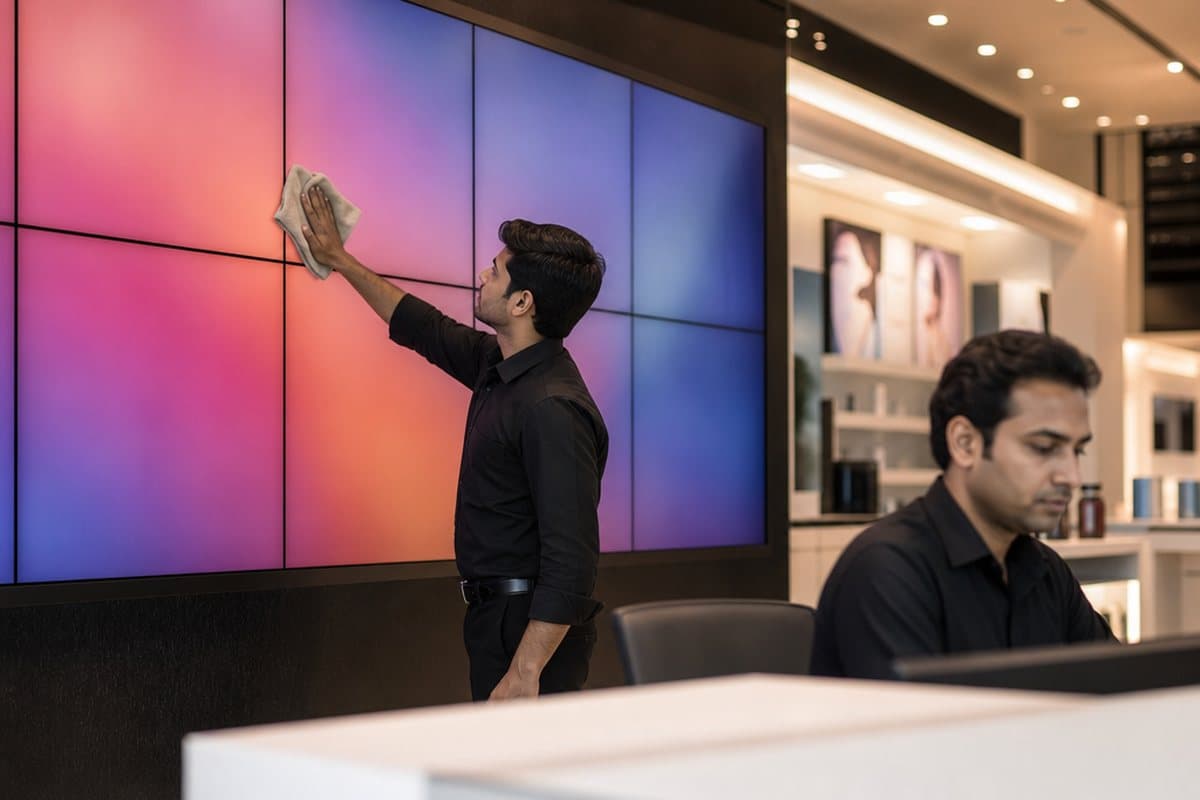
- Video walls: Multiple screens arranged together to create a large display surface, commonly used in flagship stores and malls.
- Interactive kiosks: Touchscreen displays that allow customers to browse product catalogs, check prices, or navigate store layouts.
- Digital menu boards: Widely used in quick-service restaurants (QSR) for displaying menus that can be updated in real time.
Digital signage content is managed through a content management system (CMS), allowing brands to update messaging across multiple locations from a central dashboard.
Cost Comparison: Upfront, Ongoing, and Per-Store
Cost is often the deciding factor, and the comparison is more nuanced than it appears at first glance.
Upfront costs: Traditional signage has significantly lower upfront costs. A standard glow sign board for a retail storefront may cost between INR 15,000 and INR 50,000 depending on size and materials. An equivalent digital display (commercial-grade LCD or LED) can cost INR 80,000 to INR 3,00,000 or more, plus the cost of mounting hardware, media players, and CMS software.
Ongoing costs: This is where the equation shifts. Traditional signage has minimal ongoing costs - occasional cleaning and bulb replacements. However, every time you need to change the message, you pay for new fabrication and installation. For brands running seasonal campaigns or frequent product launches, these recurring costs add up quickly. Digital signage has higher electricity costs and requires software subscriptions, but content updates are essentially free once the infrastructure is in place.
Per-store economics: For a single store with infrequent updates, traditional signage is almost always more cost-effective. For a network of 100+ stores with monthly content changes, digital signage can become more economical within 2-3 years when you factor in the cumulative cost of re-fabrication and re-installation.
Durability and Lifespan
Traditional signage, when well-fabricated, is remarkably durable. ACP facade signage can last 7-10 years with minimal maintenance. Acrylic glow sign boards typically last 5-7 years before the lighting components need replacement. The materials themselves - aluminium, acrylic, stainless steel - are weather-resistant and hold up well in Indian climate conditions.
Digital signage hardware has a typical lifespan of 5-7 years for commercial-grade displays, though this varies by brand and usage intensity. Outdoor digital displays face additional challenges - heat, dust, moisture, and direct sunlight can reduce lifespan if the hardware is not rated for outdoor use. Indoor digital displays in controlled environments tend to last longer and maintain image quality throughout their lifespan.
One important consideration: traditional signage degrades gradually (fading, discoloration), while digital signage tends to fail more abruptly (screen failure, backlight issues). Both require maintenance, but the nature of that maintenance differs.
Flexibility and Content Updates
This is where digital signage has a clear advantage. Content on digital displays can be updated remotely, instantly, and at no additional production cost. A brand can change promotions across 500 stores in minutes. Time-of-day scheduling allows different content for morning, afternoon, and evening. A/B testing different messages becomes practical.
Traditional signage offers no such flexibility. Every content change requires physical production and installation. For a brand that updates its in-store messaging quarterly, this means four fabrication and installation cycles per year, per store. For a 200-store network, that is 800 installation events annually.
However, for signage that rarely changes - store name boards, brand logos, directional signage - this flexibility is unnecessary. A well-made glow sign board displaying your brand name does not need to be updated.
Maintenance Requirements
Traditional signage maintenance is straightforward: periodic cleaning, bulb or LED strip replacement for illuminated signs, and occasional repainting or panel replacement for weather damage. Most maintenance can be handled by local technicians with basic skills.
Digital signage maintenance is more specialized. It involves software updates, hardware diagnostics, screen calibration, and connectivity troubleshooting. If a screen fails, replacement requires sourcing the same model or compatible unit. For outdoor digital signage, weatherproofing maintenance - gasket replacements, ventilation cleaning, and UV protection - adds to the maintenance burden.
For brands with stores in remote or tier-3 locations, traditional signage maintenance is significantly easier to manage. Digital signage support in smaller cities can be challenging due to limited availability of specialized technicians.
Where Traditional Signage Wins
- Storefront branding: For permanent store identification - your brand name, logo, and tagline on the facade - traditional signage is the standard. It is visible 24/7 (with illumination), requires minimal maintenance, and costs a fraction of a digital alternative.
- Budget-conscious deployments: When the priority is covering maximum stores within a fixed budget, traditional signage allows you to brand 3-5x more locations for the same investment.
- Durability in harsh conditions: In areas with extreme heat, dust, or humidity, well-fabricated ACP and acrylic signage outlasts most digital alternatives without climate-controlled enclosures.
- Regulatory simplicity: Many municipalities have stricter regulations for digital/LED signage than for static signs. Traditional signage typically faces fewer approval hurdles.
- Power reliability: In areas with inconsistent electricity supply, a traditional illuminated sign with battery backup is more reliable than a digital display.
Where Digital Signage Wins
- High-frequency content updates: Brands that change in-store messaging weekly or monthly benefit significantly from the ability to update content remotely.
- Product-heavy retail: Electronics, fashion, and QSR brands that need to showcase rotating product ranges, pricing updates, and promotional content find digital signage far more practical.
- Customer engagement: Interactive digital displays - touchscreens, product configurators, wayfinding kiosks - create engagement opportunities that static signage cannot match.
- Data and analytics: Digital signage platforms can track content playback, measure dwell time (with camera integration), and provide engagement metrics. This data informs future content strategy.
- Premium brand perception: In flagship stores and high-traffic locations, digital displays create a modern, premium brand impression that enhances the overall store experience.
The Hybrid Approach - Using Both Strategically
In practice, most successful retail brands use a combination of both formats. The hybrid approach allocates each format to the use case where it performs best:
- Traditional for permanence: Storefront glow sign boards, facade signage, directional boards, and regulatory signs remain traditional. These elements change rarely and need to be visible regardless of power availability.
- Digital for dynamism: In-store promotional displays, window screens, menu boards, and campaign-specific content use digital formats. These elements need frequent updates and benefit from remote management.
- Traditional for scale: When rolling out branding across hundreds of dealer or franchise locations - especially in tier-2 and tier-3 cities - traditional signage provides the most cost-effective path to consistent brand presence.
- Digital for flagships: High-traffic flagship stores and premium locations invest in digital displays to create differentiated experiences that justify the higher cost.
This approach optimizes spending by matching the signage format to the specific requirement at each location, rather than committing entirely to one format.
Making the Right Choice for Your Business
The decision between digital and traditional signage should be driven by four key questions:
- How often does your content change? If your signage content updates monthly or more frequently, digital signage delivers better long-term value. If updates happen once a year or less, traditional signage is more practical.
- What is your store network size and geography? Large networks spread across tier-2 and tier-3 cities favor traditional signage for ease of deployment and maintenance. Concentrated urban networks can support digital signage more effectively.
- What is your total budget over 3-5 years? Compare the total cost of ownership, not just upfront costs. Include fabrication, installation, content updates, maintenance, and replacement costs for both options over a multi-year period.
- What is the primary purpose of the signage? Brand identification (store name, logo) favors traditional. Promotional content and customer engagement favor digital.
There is no universal answer. The right approach depends on your specific business context, and for most brands, the answer is a thoughtful combination of both.
Conclusion
Digital signage and traditional signage are not competitors - they are complementary tools that serve different purposes. Traditional signage remains the most cost-effective, durable, and practical choice for permanent brand identification and large-scale deployments. Digital signage excels at dynamic content delivery, customer engagement, and data-driven marketing in high-traffic locations.
The most effective signage strategy considers both options and deploys each where it delivers the greatest value. Whether you are planning a new store rollout, upgrading existing signage, or evaluating a shift to digital, understanding the cost-benefit profile of each format is the first step toward making a well-informed decision.
