
Best Retail Execution Companies in India: Who Does What



- Which retail execution companies in India send their own people into stores?
- Why can't you rank them by their size figures?
- Who will put promoters and sales staff in your stores?
- Who will put up your displays and keep them up?
- Who will check the shelf, and how will you know they went?
- Which firm should you call first?
Ask retail execution firms in India how big they are, and each one answers in a different unit: 15,000+ employees, 25,000+ field associates, 26,500+ field reps deployed. Those numbers can't rank anyone, because each counts something different. Shortlist on the store jobs you need done (promoters, displays and their upkeep, shelf audits) and on the proof each firm brings back from every visit. Ours is a photo of the work and its location, logged in 1Channel.
Which retail execution companies in India send their own people into stores?
Eight firms say on their own websites that they put people to work in brands' stores. Retail Scan, often named beside them, sells audits and retailer payouts and describes a "pan India field footprint", but its site names no field staff.
| Company | Promoters and sales staff | Displays, POSM and upkeep | Shelf audits | Field app, as its site describes it |
|---|---|---|---|---|
| Channelplay | Managed sales teams and in-store promoters | Visual merchandising, POSM and signage; store maintenance by 1,000+ technicians | Retail audits and mystery shopping | 1Channel: geo-tagged, photo-verified installs and visits |
| Implementers | In-store promoters | Merchandising and display solutions, from its own production house | Retail audits and payouts | Vizibee: retail audit software and field reporting |
| Love In Store | Promoters and on-ground staff | POSM 360 | Execution audits and compliance monitoring | InStore IQ: store intelligence |
| Multiplier | Workforce management | Branding and signage, POP displays, fixtures, retail maintenance | Named on its About page | RetailTrack (named, not described) |
| PPMS | In-store promoters | Merchandising and channel activation | Field audits and backend photo audits | FRAMe: real-time field reporting |
| Retail Scan | Not stated | Not stated | Retail audits, an availability and visibility index, price audits, mystery audits | MyTrack (named, not described) |
| Smollan India | Assisted selling through in-store promoters | Merchandising, planogram and POSM execution | On-shelf availability and share of shelf, as merchandising work | Not named on its India page |
| TopHawks | Managed sales teams and in-store promoters | Visual merchandising | Mystery shopping and audits | TopHawks One: field operations |
| V5 Global | Contract staffing and in-shop promoters | Visual merchandising, store development, repair and maintenance | Retail audits | InField: field sales and retail marketing apps |
Why can't you rank them by their size figures?
Eight of the nine publish a headcount, and no two of them count the same thing. PPMS says 15,000+ employees across 1500 towns and cities. Multiplier says 25,000+ field associates in 600+ cities. Love In Store says 15,000+ team members in 700+ cities. V5 Global says 40,000+ associates employed. Implementers says 650+ full-time employees, 150+ cities and 15,000 stores. Smollan's India page says a 40,000+ strong team without saying whether that's India alone. TopHawks prints two people figures on one page: 26,500+ field reps deployed across 246+ cities, and 100,000+ workforce activated. Retail Scan gives no headcount. Ours are 15,000+ field sales professionals, working across 1,200+ cities.
Store counts are rarer. PPMS says its people cover 1,40,000 stores and Implementers says 15,000 stores. A store count is the figure closest to your own problem, but it still tells you nothing about which stores.
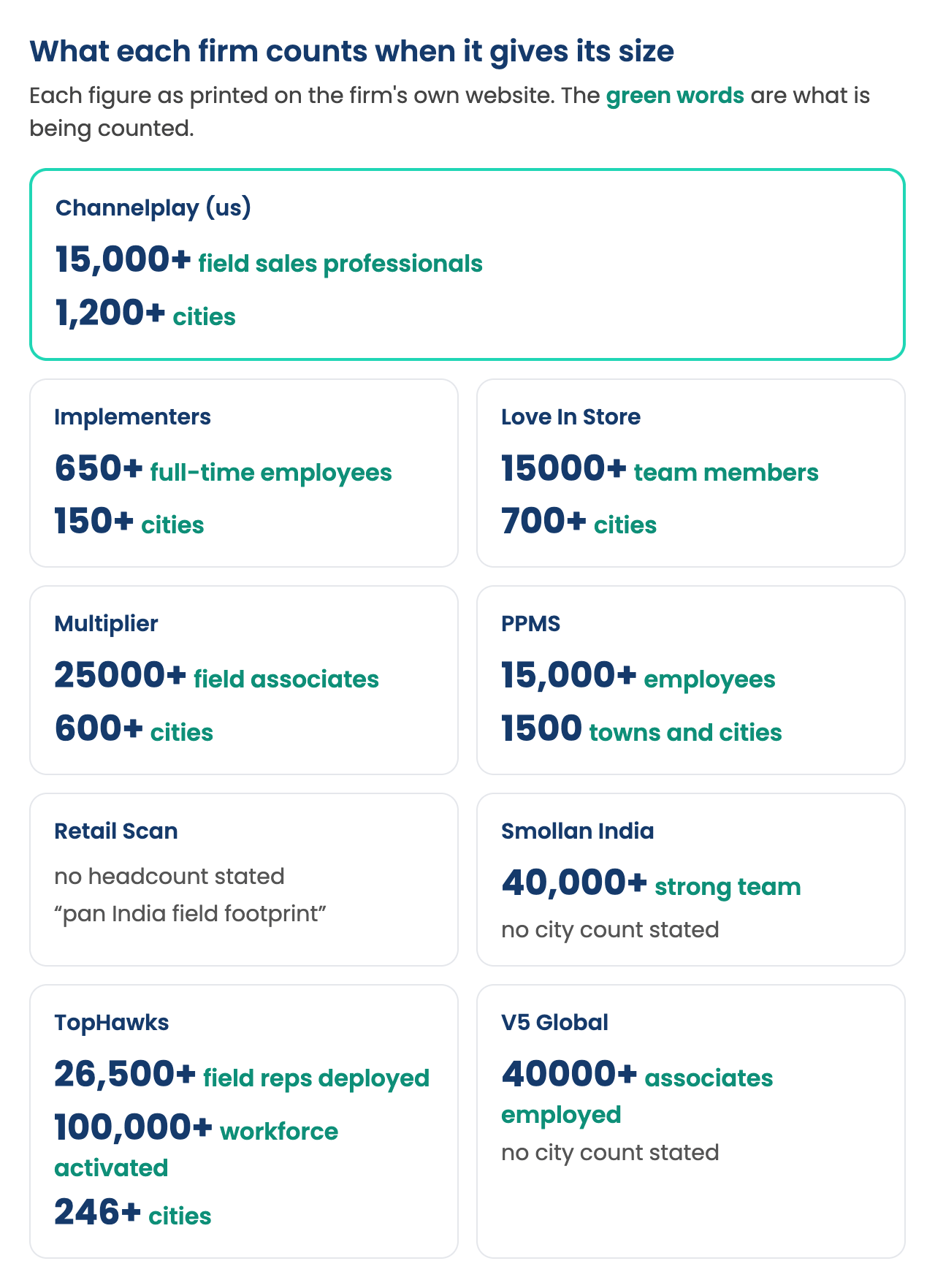
Put the figures side by side and the questions pile up. Is a headcount everyone on the payroll, or only people working in stores this month? Does "workforce activated" mean today's team, or everyone a firm has ever deployed? A city count tells you a firm has worked somewhere in a city. It doesn't tell you it reaches your outlets there, and the gap is widest in tier-2 and tier-3 towns.
So ask a narrower question. Has the firm made visits in your own towns, and can it show you what it brought back from them?
Who will put promoters and sales staff in your stores?
Every firm in the table except Retail Scan lists in-store promoters or sales staff, so the table won't tell them apart. What happens after a promoter's first day will: who employs and pays them, how they're trained on your product, and whether you can see where they were and what they did each day.
We run managed sales teams and in-store promoters for brands, and track each rep's beat plan and visits in 1Channel. We deploy a team of 100 to 500 promoters within 15 to 30 days, or 30 to 45 days when the role needs product training.
Before you sign, ask each firm three things. Whose payroll are the promoters on? How long does it take to get a trained team into your stores? And what will you see each day: attendance, visits, sales, or only a monthly summary? The answers separate firms that run the team from firms that supply the headcount.
If you sell through the general trade rather than chain stores, ask for a team that already works there. We recruit, pay and run Sleepwell's general trade field sales team in small towns, while Sleepwell keeps its own beats, targets and orders.
Who will put up your displays and keep them up?
Putting up a display takes one visit. Keeping it right takes every visit after that: a backlit sign stops working, a competitor's stand covers your POSM, a fixture breaks and nobody reports it. Ask a firm about the second part as well as the first.
We deploy visual merchandising, POSM and signage, and we keep them up. Our store maintenance team has 1,000+ technicians and closes 98%+ of tickets within the agreed time. Every install is logged in 1Channel with its location and photos, so you can check where the work was done and how well, store by store.
Ask each firm to show you a finished install from a past rollout, with its photo and location, and one maintenance job from the day it was reported to the day it was closed.
Building or rebranding a store is a different trade. Dart Design, Brandsbud and AVR Retail design, make and install fixtures, fascias and signage with their own installation crews, then hand the store over. Their sites list no promoters, merchandisers or shelf audits.
Who will check the shelf, and how will you know they went?
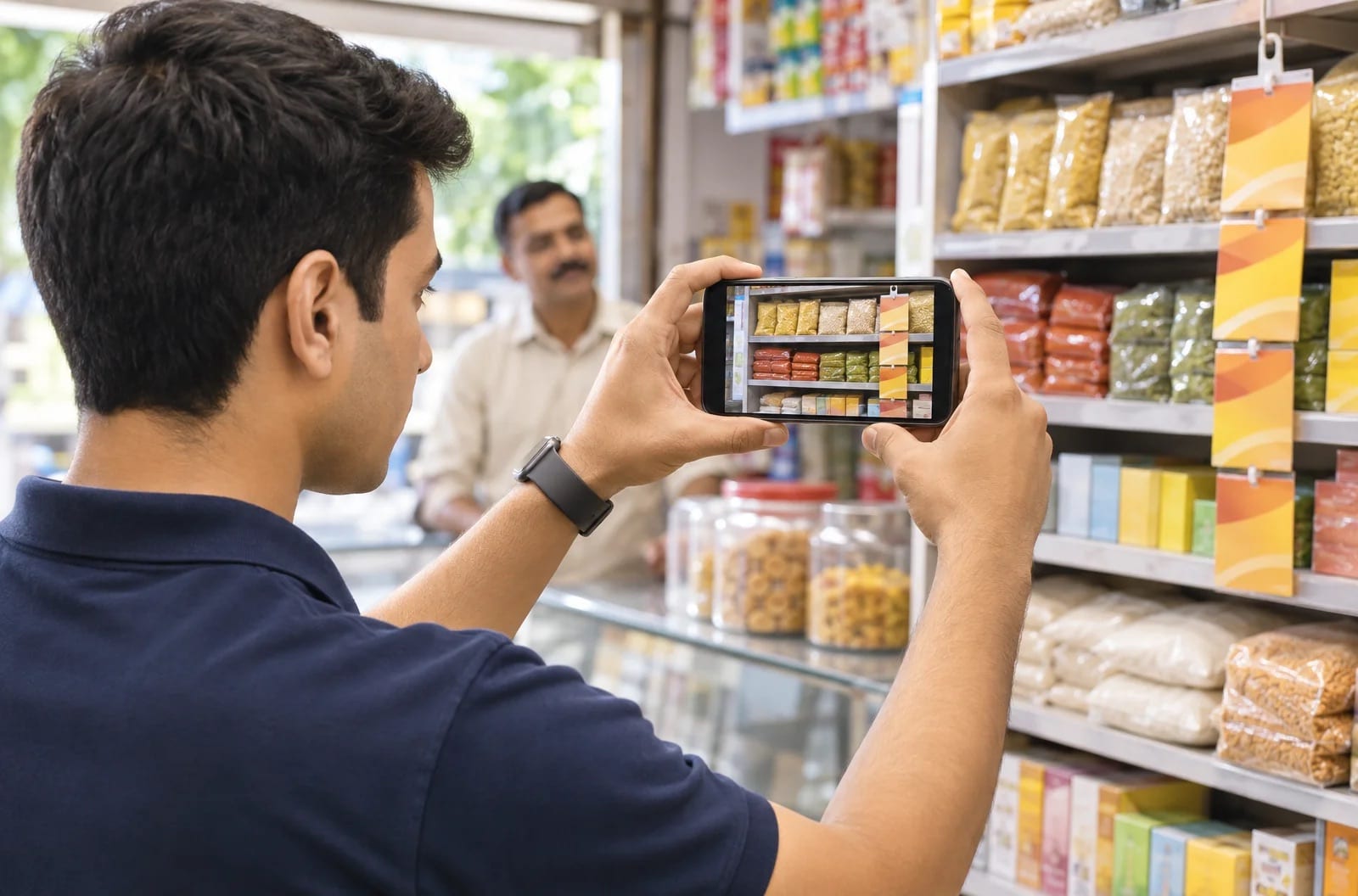
A store audit is only as good as its proof. A score without a photo from that store, on that day, is someone's word.
Our auditors record every visit and its photos in 1Channel, geo-tagged, and every submission is checked before it reaches your reports. We can start field audits within five days of sign-off.
When you compare audit offers, ask how often each store will be visited, who reviews the answers before you see them, and whether you'll get the photos from each visit or only the score.
For firms that only audit, see our lists of retail audit companies and mystery shopping companies in India.
Bizom, FieldAssist, BeatRoute, ParallelDots, Wooqer and Sterison turn up on lists like this one too. They're software companies: they sell the app, not the people. Their sites describe sales force automation, distributor management, shelf image recognition and store task tools. Your own team or a field firm still has to make the visit. The app is how you see it.
If your team already works in one of these apps, ask the field firm whether its people can report in yours or whether it brings its own. Either can work. Two systems that don't match mean matching the data by hand every month.
Which firm should you call first?
If you need one job done, the table shows who lists it. If you need promoters, displays and audits in the same stores, give all three to one firm: you skip the hand-offs, and an audit finding goes straight to the team that fixes it. That's how we run our programmes, with every visit on one record in 1Channel.
If a firm can't show you visits from your own towns, a short paid pilot in a handful of your stores will tell you more than its website can, and it costs far less than finding out after the full rollout has started. Our guide to evaluating a retail execution partner has the full scorecard for the pilot and the RFP.
