


- What Is a Retailer Loyalty Program?
- Why FMCG Brands Run Retailer Loyalty Programs in General Trade
- How FMCG Retailer Loyalty Programs Verify Kirana Purchases
- App-Based Rewards for Retailers Without Forcing an App
- Retailer Loyalty App Rewards: UPI, Vouchers and TDS
- How to Choose a Retailer Loyalty Program Company in India
- Conclusion
What Is a Retailer Loyalty Program?
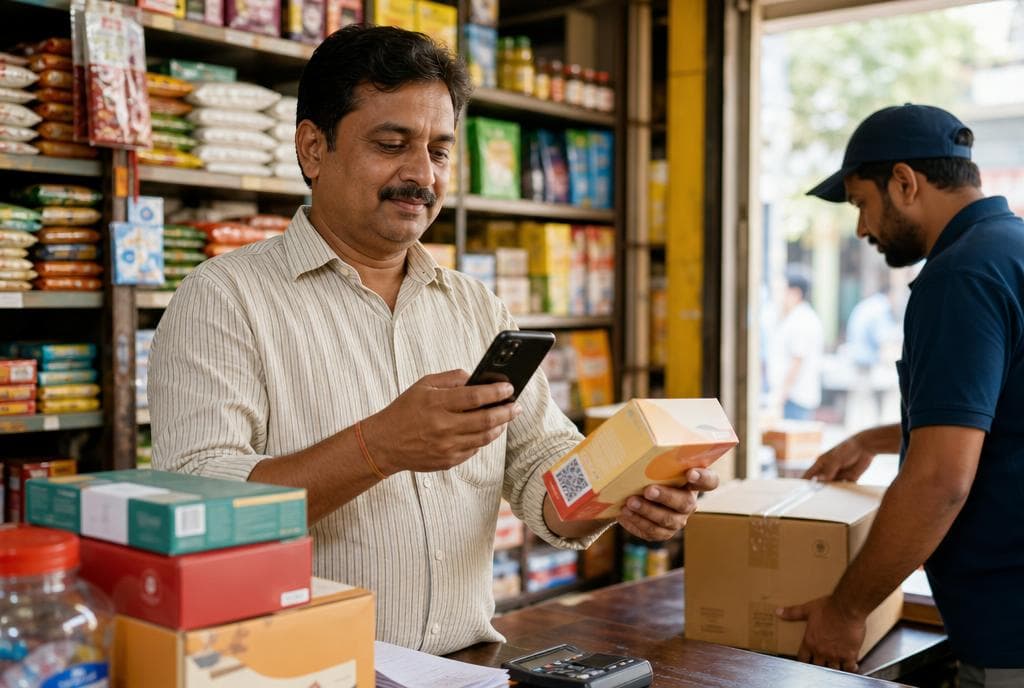
A retailer loyalty program is a scheme in which a brand rewards the shops that stock and sell its products. For an FMCG brand in India, that means kirana stores, wholesalers and other general-trade retailers earning points on purchases the brand can check, then cashing them in as UPI money, vouchers or gifts.
The points are the easy part. The hard part is the bill. A kirana rarely buys from you. It buys from a distributor, so the invoice that proves the purchase sits in the distributor's books, not yours. A retailer program is won or lost on two things that happen before any reward: proving that purchase, and letting a busy shopkeeper claim without learning an app. Get both right, pay the moment a claim is approved, and the program runs.
The term has a second meaning. Shops also run loyalty programs for their own shoppers, and most of what you find when you search "retailer loyalty program" is that kind. This guide is about the trade kind, where a brand rewards its retailers. For the shopper kind, see our consumer loyalty programs page. For programs that also reward distributors and dealers, see our channel loyalty program guide.
Why FMCG Brands Run Retailer Loyalty Programs in General Trade
General trade is where most of an FMCG brand's shops are, and most of them sit outside the brand's direct reach. ITC says its products are on sale in nearly seven million retail outlets and that more than a third of them are serviced directly (ITC Report and Accounts 2025). The rest buy through the distribution chain, and for them the brand never sees a bill of its own.
The largest companies already reach retailers through apps. ITC's eB2B platform, UNNATI, covered nearly eight lakh outlets in 2024-25, by the company's account. An ordering app records what a shop buys. A loyalty program gives the shop a reason to buy more of it, and to keep buying it from you.
Points sit on top of margin, not in place of it. A shopkeeper stocks what sells and what pays. On top of fair trade terms, a program rewards the behaviour you want: a wider range on the shelf, orders that come in every week, your display kept up, and the shop staying with you in the month a rival brand runs a richer scheme.
How FMCG Retailer Loyalty Programs Verify Kirana Purchases
Every point a retailer earns has to rest on a purchase you can prove. Our 1Channel platform takes three kinds of proof, and one program can mix them:
| Way to prove the purchase | What it proves | Where it fits | How it gets gamed |
|---|---|---|---|
| Distributor's sales feed (distributor management system, DMS, or ERP) | What each retailer bought, as the distributor billed it | Distributors who already record sales by retailer in a DMS | Fake sales entered in the DMS to earn scheme benefits, and stock pushed into shops at the end of a cycle to collect loyalty benefits meant for retailers, both on KPMG's list of fraud risks |
| QR code on each pack, scanned once | That a pack with a code reached someone with a scanner | Brands that can print a code on packs or cartons, and shops whose distributor has no DMS | A single-scan code can't be claimed twice, but a scan shows the pack was in hand, not that the shop sold it |
| Invoice upload with two approvals | That a bill exists and someone checked it | Shops that buy from a distributor with no DMS feed, or from a wholesaler | A made-up or reused bill; the second approval, by your sales team, is the check |
KPMG India's list of sales and distribution fraud risks also names fictitious retailers created to show wider reach, and falsified acknowledgements for scheme benefits that never reached the eligible recipients (KPMG). Both are reasons to tie every member to a KYC check and every reward to a claim someone approved.
Before launch, decide who checks a claim and what a retailer is told when one fails. A shopkeeper who loses points without a reason stops claiming.
App-Based Rewards for Retailers Without Forcing an App
An app is the obvious way to run a retailer program, and also where many programs stall. HUL's case study of its retailer app Shikhar for the MMA awards says 1.3 million retailers were registered, but the installs "didn't convert into adoption" (MMA). One kirana owner in a Flourish Ventures survey of 200 stores said: "I am busy serving customers and so I don't have time to learn about new online tools. I would be more likely to use these apps if I had help understanding them" (Flourish Ventures).
So keep the app, but don't make it the only way in. On 1Channel, a retailer joins by OTP: they sign up themselves, you upload a list in Excel, or your sales team nominates them. KYC is done with PAN and Aadhaar. After that, a retailer can claim points and redeem rewards in the app, on WhatsApp, through our call centre, by emailing our helpdesk, or through their field rep. Our standing helpdesk team works in 10 regional languages.
The app still matters for the shops that use it. In the retailer program we run for TECNO, the smartphone brand, retailers track their sales, check their points and redeem rewards in the app, and depend less on sales reps for it. The helpdesk of more than 50 regional-language agents set up for that program also monitored engagement trends and reached out to retailers proactively.
Count the right thing. A registered retailer is not an active one. 1Channel reports members as active, inactive and never active, and the never-active list is where a program quietly fails.
Retailer Loyalty App Rewards: UPI, Vouchers and TDS
Pay fast. On 1Channel, points reach the retailer's wallet as soon as a claim is approved, and when the retailer asks for a UPI payout, the money reaches their bank account straight away. Retailers who prefer vouchers can take those instead. Both go out with tax deducted.
Check the tax before you choose the reward. The tax department's guidance on Section 194R says sales discounts, cash discounts and rebates need no TDS, but other incentives in cash or kind do: once the benefits a retailer gets from you pass Rs 20,000 in a financial year, you deduct 10% on the whole value, not just the part above the threshold (Income Tax Department). Under the Income-tax Act, 2025, the same 10% and Rs 20,000 sit in Section 393(1). Whether your points count as a taxable benefit is a question for your tax adviser. Our channel incentive programs guide goes through each reward type.
How to Choose a Retailer Loyalty Program Company in India
Most of the companies you'll find sell a platform: the app, the points engine and the reports, which your team then runs. Some also do the work around it. For a retailer program, that work is most of the job: enrolling shops, checking claims, answering shopkeepers in their own language and paying on time.
Ask any provider:
- How do you prove a kirana's purchase when its distributor has no DMS?
- Can a retailer claim without the app, and in which languages?
- How long does it take from an approved claim to money in the retailer's bank account?
- Who calls the retailers who signed up and never claimed?
- Can the program run on our own app if we already have one?
Channelplay does both: the platform and the people who run it. We run programs on 1Channel, and we have also done the field work on a brand's own app: for Bosch, our field team brought sub-dealers onto Bosch's loyalty app. Our dealer and distributor loyalty programs page explains how we set up and run a program.
Conclusion
Start with your shops, not your catalogue. Sort them by how they buy: billed through a distributor's DMS, buying packs you can code, or buying on paper from a wholesaler. That tells you which proof each one needs. A month after launch, read the never-active list. It tells you whether your claim routes are reaching the shopkeepers who will never open an app.
