
Sales Incentive Programs for Field Sales Teams in India



A sales incentive program pays salespeople extra, on top of their fixed salary, for hitting targets or for the work that leads to sales. The reward can be cash per sale or per target slab, a contest prize, points that turn into money or vouchers, or recognition such as a place on the weekly leaderboard.
For a field sales team, we'd pay for the day's work, all month, and keep contests for the weeks that need a push. A month-end target pays once, for a number a promoter or field sales officer only partly controls. The beat walked, the new outlet signed and the display put up are theirs to do every day, and a program that credits them as they happen gives the team a reason to work hard on the 12th, not just in the last week's rush.
What Is Incentive in a Sales Job?
For the salesperson, an incentive is the part of pay that moves with results: money on top of fixed salary, earned for sales, a target or a task. Commission, a percentage or a fixed amount per sale, is one kind of incentive.
For the brand, a sales incentive program is the set of rules behind that pay: what earns it, how each claim is checked, and how often and how it's paid. Run all year, with points, tiers and recognition alongside the cash, it becomes a sales team loyalty program. Rewards for dealers, retailers and their counter staff, paid through the dealer, are a different kind of scheme, covered in our guide to channel incentive programs.
What Are the Four Types of Sales Incentives?
Every guide counts them differently. We build field programs from four:
- Variable pay and commission: an amount per unit sold, per slab of a target, or a share of the target achieved, paid with salary.
- Spot incentives and contests: a short push with an end date, such as a fixed amount on each unit of a new model in launch week (a SPIFF), or a prize for the team that opens the most outlets in a fortnight.
- Non-cash rewards and recognition: vouchers, gadgets, a trip for the top performers, a name at the top of the weekly leaderboard.
- Year-round points: points for each piece of work, built up over months and redeemed for money or vouchers, often with tiers.
The first and last pay for the everyday work. The middle two buy a burst.
Sales Incentives for Employees in the Field: What to Pay For
A field sales officer on a general trade beat, a promoter in a multi-brand store and a merchandiser on display rounds all sell through a day of small jobs. Pay for the jobs they control, as often as those jobs happen, and check each one against a record before it's paid.
| What the rep does | How often it can be credited | The record that proves it |
|---|---|---|
| Makes a sale | Each sale, or each day | The sale entered in the field app, with the invoice or the product's serial number |
| Visits the outlets on the beat | Each day | A check-in at each outlet, logged in the field app with its location |
| Opens a new outlet | Each outlet | The outlet added in the app, and its first order |
| Sells more of the range | Each week | The number of product lines on each order |
| Puts up a display | Each display | Before and after photos, approved by a manager or checked in an audit |
| Helps the team hit its target | Month end | The team's total from the sales data |
A job with no record behind it is hard to pay fairly. Keep it for recognition, not cash.
Two ways to pay a field team for the same month
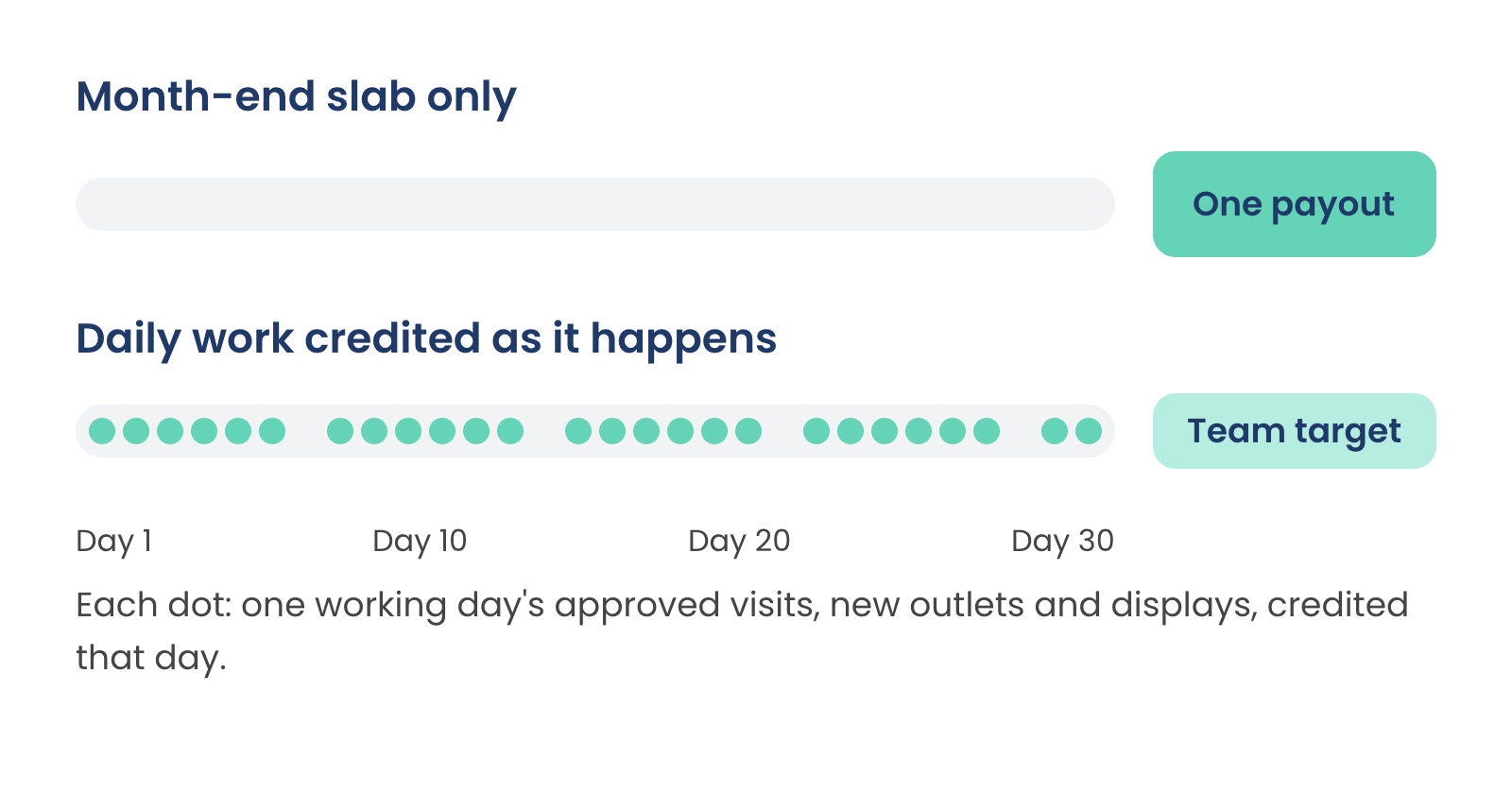
Sales incentive calculation formula. For daily work, the incentive is the number of approved activities in the period multiplied by the fixed amount set for that activity, added up across the activities you pay for. For a target slab, it's the amount or percentage set for the slab the rep reached. Keep each one simple enough that a rep can work it out on a phone.
Keep the month-end slab gentle. In a study of enterprise software sales, reps timed deals and agreed to lower prices so they would land in the quarters where steeper commission rates paid more, and the mispricing cost the vendor 6% to 8% of revenue. A field team isn't selling software, but a slab that pays far more just past the line invites the same last-week rush.
Pay soon after the work is approved. A reward that turns up two months after the display went up doesn't feel like a reward for the display. On 1Channel, our field and loyalty app, points reach a member's wallet as soon as a claim is approved, and a UPI payout they request reaches their bank account straight away.
Examples of Sales Incentives: When a Contest Helps
A contest earns its place when one week matters more than the others. Good uses for a field team:
- Launch week for a new model: a fixed amount on each unit sold, ending on a set date.
- Festive season: a prize for the top sellers in each city across the Diwali weeks.
- A new-outlet sprint: the team that opens the most outlets with a first order in a fortnight wins.
- A display contest: the best before and after photos, judged by the regional manager.
- A range push: extra for each order that carries a line from the new pack.
Give each contest one goal and an end date, and run it on top of the daily credits, never in place of them.
Sales Incentive Structure for Outsourced Sales Teams
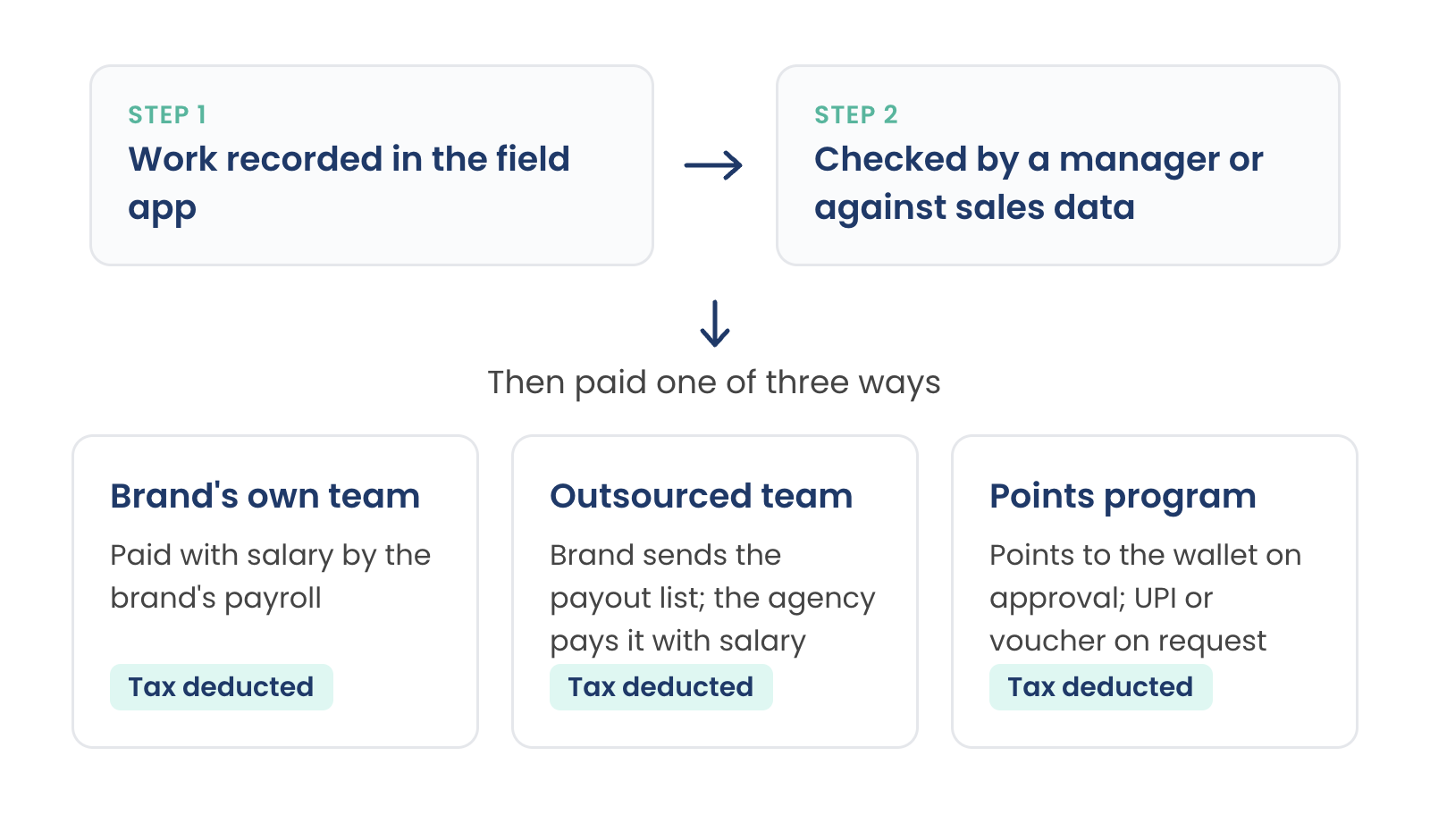
Many brands run their promoters and field sales officers on an agency's payroll. The incentive still has to follow the brand's targets, so the structure needs one more step: who prepares the payout, and who pays it. In the managed sales teams we run, the split looks like this:
- The brand keeps the targets. For Sleepwell's general trade field team, Sleepwell keeps the beats, targets and sales management, and the field sales officers are on Channelplay's payroll.
- The brand prepares the payout list, and the agency pays it. For Airtel Payments Bank, Channelplay pays field staff from the attendance and payout list the bank prepares.
- One app for the work and the pay. On Oura's promoter program, promoters log daily tasks and rival sales in one app, a leaderboard goes out every Friday, and payroll, hiring and incentives run from the same app.
Write three things into the agency contract: the incentive rules, the record each one needs, and the date each month when the payout list is due. A late list means a late payout, however quickly the payroll runs.
Where a field incentive is paid from
Does Incentive Come Under CTC?
Usually, yes. CTC counts fixed and variable pay together, and incentives sit in the variable part. Read the offer letter for which incentives the stated CTC assumes: that part of the figure isn't guaranteed.
Income tax. An incentive or commission paid to an employee is salary. Section 16 of the Income-tax Act, 2025, in force since 1 April 2026, counts "any fees or commission" and "profits in lieu of, or in addition to, any salary or wages" as salary. The employer deducts tax on it when it's paid, under section 392, so it goes through payroll like the rest of the salary. For staff on an agency's payroll, the agency deducts it.
Gifts and vouchers. Under rule 15 of the Income-tax Rules, 2026, gifts, vouchers and tokens from an employer are tax-free while their total for the tax year stays below Rs 15,000. At Rs 15,000 or more, the whole value is taxed as a perquisite (a benefit counted as part of your pay), not just the part above the limit. Keep each person's contest prizes and vouchers for the year under Rs 15,000 where you can.
Wages under the Code on Wages. The Code on Wages, 2019, in force since 21 November 2025, leaves "any commission payable to the employee" out of wages. But if the listed payments it leaves out, such as commission, house rent allowance and overtime, come to more than half of an employee's total pay, the amount above half is added back into wages. If most of the pay is incentive, more of it can count as wages. Check this when you decide the split between fixed pay and incentives.
Rewards paid to a dealer's or retailer's own staff through the dealer fall under the TDS rule for business benefits instead. Confirm the treatment for your program with your tax adviser before launch.
Conclusion
Credit the work a field team does every day, as soon as it's checked, and keep the month-end slab gentle. Then a contest is what it should be: an extra push for one week, not the reason anyone works the other three.
