
What Is POSM? Full Form, Meaning and Types in Retail


What is the full form of POSM?
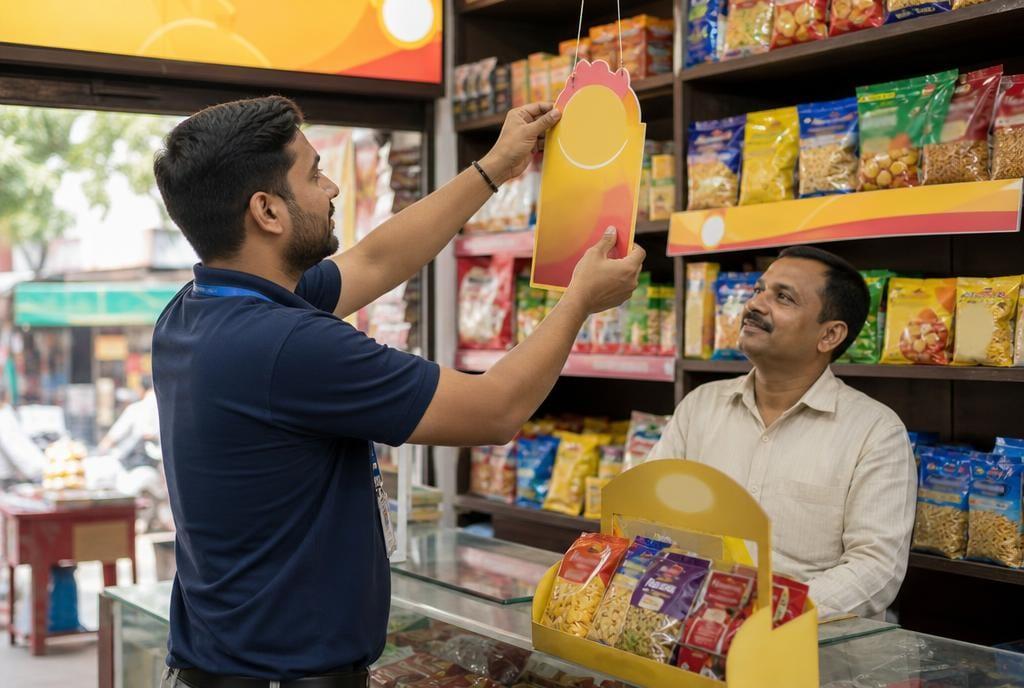
POSM stands for point of sale material: the danglers, shelf strips, standees, counter displays, glow sign boards and other branded pieces a brand puts inside a store and on its front to catch shoppers where they choose. Some marketers read the M as marketing. Either way, none of it sells a thing until a shopkeeper agrees to put it up.
It covers anything printed or built to carry a brand's message at the point of sale, temporary or permanent, inside the shop or on its front. A TV spot or a highway hoarding isn't POSM, and neither is the pack itself.
What is the difference between POS, POP and POSM?
POS is where the shopper pays, POP is where they choose, and POSM is what a brand puts at either. Monash University's marketing dictionary describes point-of-purchase displays as signs, display cartons and the like, used "to impel on-the-spot buying". In Indian retail the terms blur, and "POP material" usually means the same danglers and standees as POSM.
| Term | Stands for | Example |
|---|---|---|
| POS | Point of sale | The billing counter in a supermarket; the card machine at a kirana |
| POP | Point of purchase | The shelf, the aisle end, the kirana counter top |
| POSM | Point of sale material | A dangler over the shelf; a counter display unit beside the billing desk |
What are the types of POSM?
Most lists sort POSM by shape. A brand deciding what to print needs two more facts about each piece: who has to say yes before it goes up, and how it usually fails. Small temporary pieces go up easily and come down just as easily. The bigger and more permanent the piece, the more people have to agree, and the longer it tends to stay once they do.
In the shop, temporary
| Type | Where it goes | How long it stays up | Who has to say yes | What usually goes wrong |
|---|---|---|---|---|
| Dangler | Hangs from the ceiling or shelf edge above the product | One campaign, a few weeks | The shopkeeper or store manager | Taken down when it gets in the way, or left up long after the offer ends |
| Wobbler | Clips to the shelf edge next to the product | One campaign | The shopkeeper | Knocked off, or ends up beside the wrong brand |
| Shelf strip (shelf talker) | Runs along the front of the shelf | One campaign to a few months | The shopkeeper; in modern trade, the chain | Covered by price labels or a rival's strip |
| Tent card | Stands on the counter | Days to weeks | The shopkeeper | Pushed aside to clear the billing desk |
| Poster and bunting | Wall, glass door, strung across the shop | One campaign, often a festival | The shopkeeper | Faded, torn, or covered by the next brand's poster |
In the shop, permanent
| Type | Where it goes | How long it stays up | Who has to say yes | What usually goes wrong |
|---|---|---|---|---|
| Standee | On the floor near the entrance or the category | Weeks to months | The shopkeeper or store manager | Takes floor space, so it ends up in the back room |
| Counter display unit | On the counter by the billing point | Months | The shopkeeper | Filled with another brand's stock |
| Floor stand unit (FSU) | On the floor as a small shelf of its own | Months | The store owner; in modern trade, the chain | Needs floor space the store would rather give to stock |
| Branded fridge or rack | Inside the store, fixed or plugged in | A year or more | The store owner | Stocked with rival products |
On the shop front
| Type | Where it goes | How long it stays up | Who has to say yes | What usually goes wrong |
|---|---|---|---|---|
| Glow sign board (GSB) | Above the shop front, lit from inside | A year or more | The shop owner, and often the local authority | Lights off, wiring faults, or put up without the permission it needed |
| Flange board | Sticks out from the shop front at right angles | Months to a year | The shop owner | Bent, faded, or turned away from the road |
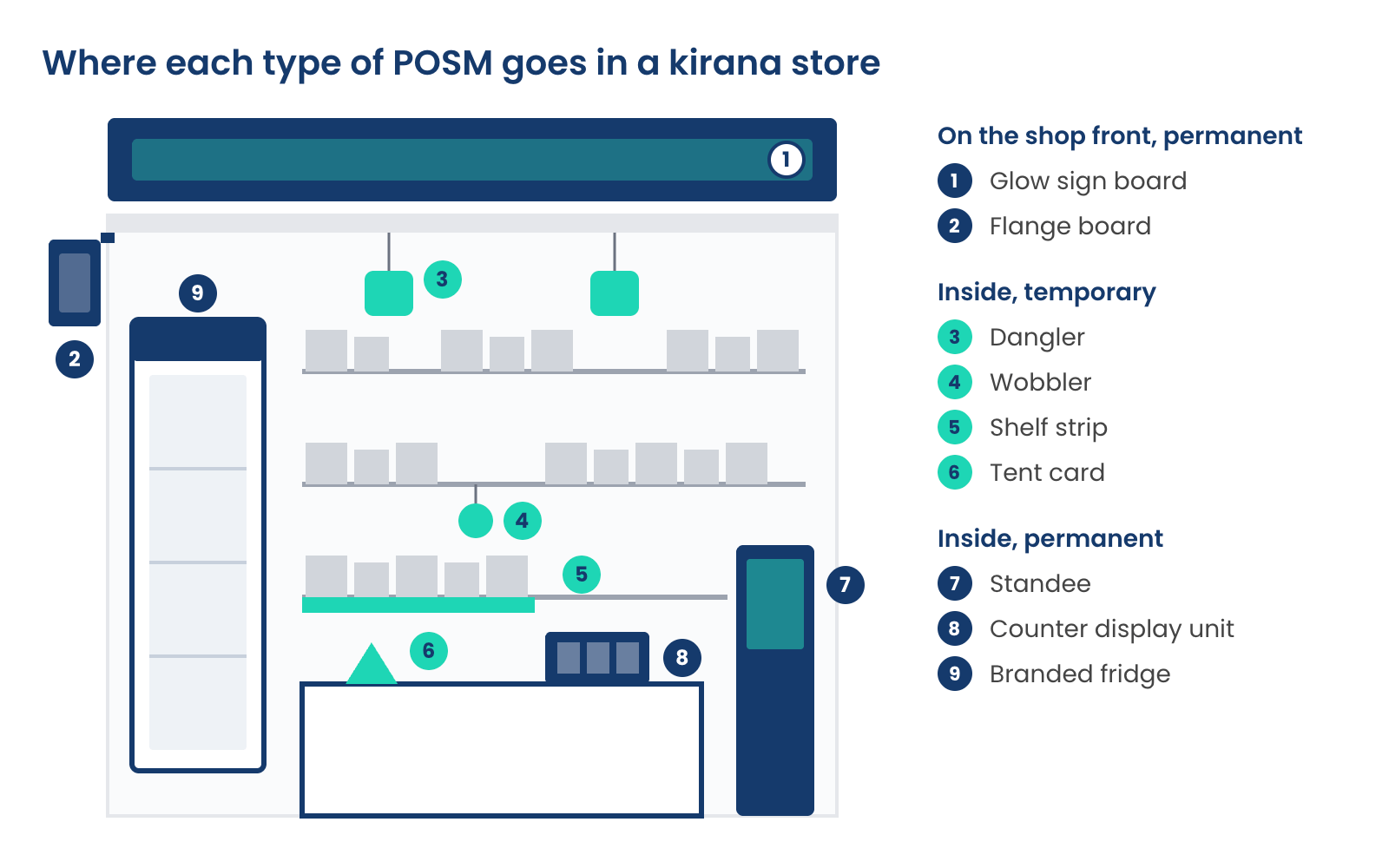
For photos of each piece, see our guide to POSM elements. Flanges have their own flange signage guide, and glow sign boards a note on signage permissions in India.
What is POSM in FMCG?
In FMCG, POSM is mostly the temporary kind: danglers, wobblers, shelf strips and posters in kirana stores, changed with each campaign, festival or launch. Durables, paint and phone brands lean more on permanent pieces in dealer stores, such as counter displays, shop-in-shop units and glow sign boards. That changes the work. Temporary pieces need someone to go back and check they're still up. Permanent pieces need the dealer's yes, and someone to fit them.
How much POSM actually goes up?
Less than most brands assume, and the bigger pieces fare worst. Researchers at the University of Texas at Austin put sensors on promotional displays sent to US stores. A third of them, about 5,000, were never installed, and only 2% went onto the floor and came off it on time. Larger, more complex displays were far less likely to reach the floor at all. The stores' reasons will sound familiar to anyone who runs a shop: displays are a hassle to put together and take apart, they take up back-room space, and they clutter the floor.
In India the loss can start before the material reaches a store: KPMG India lists POSM that is never handed to channel partners, and is instead "sold in market or sold as scrap", as a risk in a brand's sales and distribution spend. At the store, the owner has the last word: one of our own visit reports records a dealer who refused, so the POSM never went up.
So order pieces the shop has room for and the owner will keep, and plan for someone to put each one up and photograph it. Our POSM deployment page shows how one of those store visits runs.
How do you check that your POSM went up?
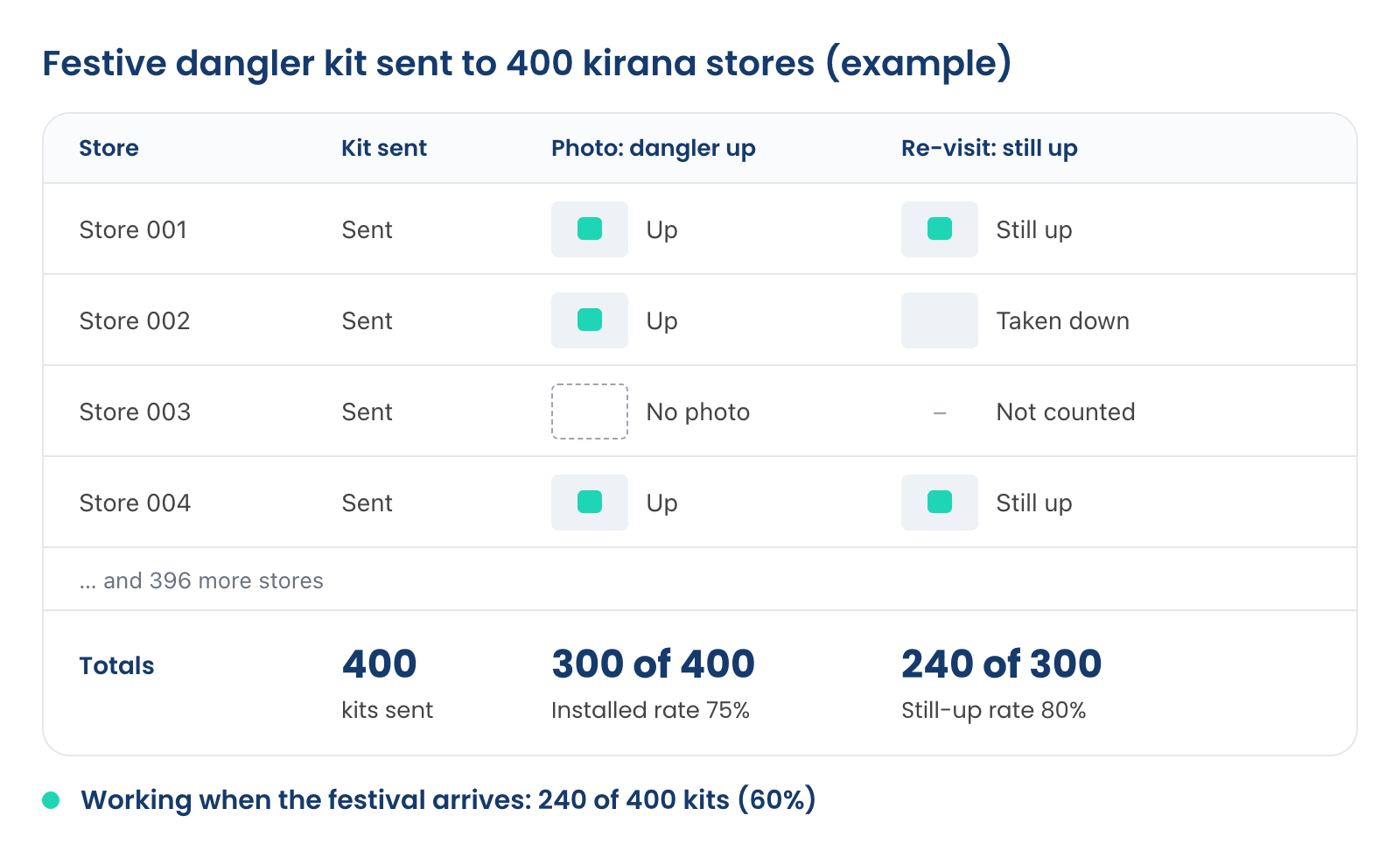
- Installed rate: stores where the POSM is up and photographed, divided by stores that were sent it.
- Still-up rate: stores where it is still up at a re-visit, divided by stores where it went up.
Here's a worked example, in round numbers. A brand sends a festive dangler kit to 400 kirana stores. Photos come back from 300 stores showing it up, an installed rate of 75%. At a re-visit two weeks later, 240 of those 300 still have it, a still-up rate of 80%. So 240 of the 400 kits, 60%, are doing their job when the festival arrives.
Ask for both numbers. A report that counts kits dispatched counts the printer's work, not the store's. Our field teams photograph the product without the POSM and again with it, and log both in 1Channel, so you can check where each piece went up and how well. Our guide to quality checks in visual merchandising covers what each store check should look at. Across a large network, this becomes an audit: our POSM audit for Vivo covered more than 25,000 stores in 24 states.
Conclusion
POSM only sells in the stores where it's up. Pick each piece for the shop it's going into, not for how it looks in the mock-up, and judge the campaign by how many stores still have it up when the offer runs.
